

Round 1

#2 Connemara vs #15 Highland Park 12
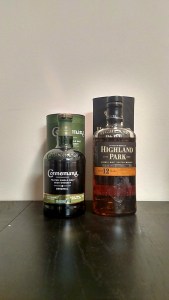
Connemara
I have said it before, and I will say it again: for people who are fans of both Scotch and Irish whiskies, this is a must-try. The flavor has the light sweetness of an Irish whiskey up front, but thus is quickly surrounded by peat and smoke, though still lighter than will be found in many scotches. It goes down rather somewhat hot and has a decent burn. In the end, the Connemara comes across as slightly more sippable and sessionable (that almost feels sacrilegious to say given how excellent the Highland Park is as well).
Highland Park
The Highland Park 12 offers a great balance of fruity sweetness and leathered smoke. The smoke expression isn’t quite as earthy as more peated Scotches and comes as part of a balancing act with that sweetness. There is some almost chocolate sweetness in the middle as the flavor goes from a fruitier to a smokier expression. This Scotch also brings the heat a but, really warming, almost burning, the throat.
Winner: Connemara
Note
This note is written pre-tasting. These two are among my favorite whiskeys and two of the bets I’ve tried this year. It’s a terrible shame they’re positioned against each other I’m the first round, as I could have seen either of them as serious contenders.
#7 Jura 16 Year Diurach’s Own vs #10 Tullamore D.E.W. Phoenix
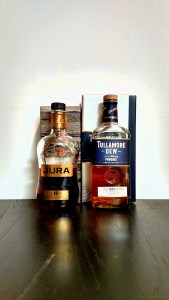
Jura
This is the first Scotch I remember ever really enjoying drinking. Tasting it again for the first time in a while, it’s no surprise to me. This is rather sweet for a Scotch with dominant chocolate coffee tastes forming most of the taste you get. This sweetness is definitely different, however, from what you’d find in a Bourbon, wheated whiskey, or Canadian Whisky and has several layers of flavor. When it first touches your tongue there’s the briefest wood and spice which quickly transform into that sweetness. The mouthfeel is surprisingly dense, considering how smooth it feels. The aftertaste is rather short, also fairly sweet like a dulled version of the tastes before it, and has minimal heat or burn.
Tullamore D.E.W. Phoenix
Even though I knew it was 110 proof, the first sip caught me by surprise (even more surprisingly, there was little to no heat as it passed over my tongue, it all came once it hit the back of my throat). The second sip proved much more mellow. Regardless, this certainly has a noticeably alcoholic flavor, although presented nicely. Again, considering the ABV and the prominence of the alcohol flavor, it is surprising how much sweetness there is to this – but more of a caramel or toffee sweetness. The sweetness almost sticks in your mouth and really develops as the aftertaste. After swallowing, the alcohol aspect definitely comes forward – there is a unique sensation that feels almost as though the alcohol vapors come back up into the nose and mouth for a moment after swallowing, bringing some spice and burn along with them. For a higher proof spirit though, this does a fine job maintaining some of the expected characteristics of an Irish whiskey (lighter, smoother, perhaps sweeter though this may be even more so) while adding a bit of extra punch for those who want it. Oddly, I’d also reccomend this to drinkers who like Canadian Whiskey but who feel those can be too sweet or a little flat in profile
Winner: Jura
#3 Ledaig 10 vs #14 Teeling Small Batch

Ledaig
Very light moutfeel and very soft. Nearly no taste whatsoever at the very front end, but that quickly changes and you get a rush of wood and smoke. Interestingly, even then, it still feels very light, but absolutely full of flavor. The box says “wonderfully peated” and that seems a fair description – peat, some oaky wood, and ethanol are the main flavors you get. As you swallow there is some spice against the back of your throat and a nice warms that passes down to your stomach, with a peppery smokey taste left behind in the mouth.
Teeling
Like many Irish whiskeys, this is quite light, although the liquid feels a bit denser and perhaps more viscous than one commonly gets from an Irish whiskey. There is a heavy sweetness (likely from the 6 months spent in rum casks) mixed with a but of ethanol up front, the middle is pretty short, with those flavors fading, and the end gives a slight kick of ethanol against the throat and into the nose with a slight and mild sweet wooded aftertaste. I appreciate the way the sweetness and the ethanol, alcohol taste balance one another, and the little bit of oomf at the end gives some backbone to the sweetness. Whereas many Irish whiskeys can be very light in texture and/or flavor, this provides that typically smoothness with maybe a bit of unique character on top.
Winner: Ledaig 10
#6 Glenmorangie vs #11 Dalwhinnie 15

Glenmorangie
Surprisingly gives you some wood right on the front which quickly is followed by a slight ethanol then a burst of nuttiness, maybe hazelnut, before kicking in a second wave of ethanol. This is light and smooth with that nutty sweetness strongly pronounced throughout and lingering long after it’s swallowed.
Dalwhinnie
This is a super light Scotch, but, tasting it again, I’m pleased that it has more to it than I thought the first time I tried it. Unfortunately, while the tastes that do present themselves are quite good, they only show up on the back end and fade rather quickly. Up front you get a near water-like experience. It builds some character in the middle, but still very subtle, then, almost as your swallowing, a burst of (very) mild peat smoke and nice wood, balanced with a floral element appear for a moment before fading quickly. The aftertaste is very clean and natural tasting, borrowing mostly from those floral notes. If you want something more easily sessionable, prefer smooth, light whiskeys, or are new to Scotch, this could be right up your alley.
Winner: Glenmorangie
#4 Tyrconnell vs #14 The Irishman Founder’s Reserve
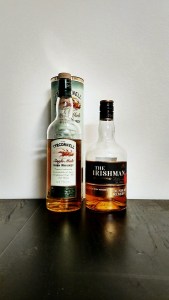
Tyrconnell
Light in the mouth and a little oily on the tongue. At the onset and through the middle, there isn’t a ton of flavor – it’s nice and light, slightly sweet, and mostly texture. The finish really brings our Tyrconnell’s character, delivering much more fruity sweetness with subtle hints of wood and the slightest bit of spice – some sips bring this spice up into the nose, but there is no burn whatsoever in this whiskey. The flavor sits on the tongue long after you’ve swallowed, leaving you with a great, mild sweetness on your tongue.
The Irishman
Also very light, but without the heavier texture expressed by the Tyrconnell. This similarly doesn’t bring very much until the mid and end. Out of the watery start you get some more ethanol/alcoholic notes as the first real taste delivered with a slight hint of woodiness (very slight). It doesn’t develop much and briefly leaves that flavor in the mouth. This goes down extremely easily and smoothly, but there is not a ton of depth to it.
Winner: Tyrconnell
#5 Bunnahabhain 12 vs #12 Aberfeldy 12

Bunnahabhain
This is a lighter Islay Scotch that starts off fairly mild. It gives actually an almost sweet taste, certainly more so than peat or smoke. The mid is almost chocolatey with a decent bit of wood as well. The finish brings some heat with it – enough to let you know it’s there, but in a pleasantly warming manner more so than a burn. Some sips send some of that heat up to the nose and after a few sips my lips were a bit prickly. The end does also have a slight alcohol bite to it, which fades very quickly. The finish lingers a bit, leaving more of the chocolate-like sweetness in the mouth while warming the chest.
Aberfeldy
This Scotch is very smooth, sweet, and quite light. When I taste it, I get a very strong coffee flavor that comes through with more subtle chocolate sweetness and oak cues beneath. There is the slightest but of raw alcohol flavor, but in total it is very nice on the sweeter end. This has no real heat or burn and goes down very smoothly. The finish is fairly short.
Overtime
I got a good bit more of the woodiness in the second go round with the Bunnahabhain and it came across a bit sweeter as well. The Aberfeldy stayed true to its strong coffee and chocolate notes. These two are actually somewhat similar tasting and and both balance their sweetness while subtly cueing chocolate notes. To my taste neither is vastly complex, the Bunnahabhain probably develops a bit more as you drink it. But there is something I really enjoy about the way the Aberfeldy presents that coffee-chocolate flavor mixed with some other Scotchy notes. I’ve gone back and forth on this more than any tasting so far in Whiskey madness. On a different day this could have gone the other way, but I have to choose one. I will add that, even with the overtime (and I actually had to give it a total of six tries, going back and forth in my indecision and getting myself a bit toasty) tasting, and the incredible closeness of these, I’m left wanting to sip more of both. These are both excellent and are variations on a theme. In the end I give it to the Bunnahabhain for showing a bit more woodiness, that bit of warmth, and feeling like it presented a bit more Scotchy character; but I’ll add that the Aberfeldy is likely more sessionable.
Winner: Bunnahabhain
#8 Talisker Storm vs #9 2 Gingers

Talisker Storm
This comes right at you with wood up front, but balanced by a sweetness – candied nuts maybe? These flavors build very nicely as it moves back to your throat or as you add another sip. A little bit of peat smoke creeps in as well, but really as a compliment to the other flavors. It goes down pretty smooth, with just a touch of bite and then a nice warmth that follows and occasionally a bit of pepper up to the nose. The finish is unfortunately short, and the aftertaste is rather mild, but the ball of warmth stays in the lower throat/chest for a good time afterward.
2 Gingers
2 Gingers is an excellent Irish whiskey (and it doesn’t hurt that it is incredibly value-friendly). Like most Irish whiskey, it is very light. Tasting it here, I was surprised that the first sip almost had bourbon notes, just toned down a bit, which are very pleasant. In the mouth it’s light and slightly viscous. You get a surprising amount of wood on top of and balanced sweetness with undertones of peppery spice. As I sip it more, the flavors present themselves a bit differently, showing an unexpected complexity. This is a drink I could see being highly sessionable given its lightness, very flexible insofar as it could be mixed or enjoyed straight, and enjoyable to a people with wide range of preferences.
Overtime
I will admit that when I saw how the seeding broke, my biases preceded me with these two. I fully expected the Talisker to be my preference, but after trying them side-by-side it was too close to call in just one tasting. I appreciate the heavier and woodier nature of the Talisker as well as the way it presents a slight bit of heat but in very favorable step with the rest of the flavors. On the flip side, 2 Gingers is an intruiging balance of lightness and complexity that makes it a joy to drink. Overall, I think the Talisker may be a slightly better whiskey – at least for my liking – but I expect it is one that would probably not appeal to as broad of an audience.
Winner: Talisker Storm
#1 Bushmills 16 vs #16 Tullamore D.E.W.
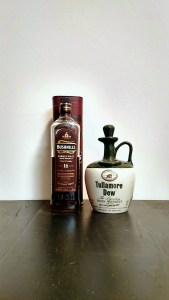
Bushmills
Very heavy in the mouth – both in density of texture and richness of flavor. It had been a good while since I’d last tasted this, and the first sip actually made me say “oh my god.” The sweetness of the various casks comes out in full force, and that density and almost syrupy character Port Wine shows through, although my first thought was Sherry (which it also spends time aging in). While sweet is probably the flavor characteristic I would most use to describe it, it is a carrot different sweetness from what you get in Bourbon or Canadian whisky: far less sugary or corn and much stronger notes of dried fruit. It is exceptionally smooth and only once in every couple of sips does it present any heat at all. The finish lasts a medium amount of time, and I wish it lasted longer.
Tullamore
Tullamore D.E.W. is light and nicely sweet, with a touch of alcohol showing through. It actually has a fairly unique taste I’m having a hard time placing: it’s sort of a mix of molasses sweetness with a bit of dank mugginess that I enjoy, even though I can’t quite put my finger on it. Tullamore is slightly heavier in the mouth then some other Irish whiskeys, but definitely still on the lighter side overall. There is the tiniest bite that comes along with the undones of raw alcohol, but in all these are nicely balanced. The finish/aftertaste is fairly medium in length and presents much of the same character as what comes before it. This is one that’s easy to drink and you may well find yourself reaching for another sip before the aftertaste has fully faded. I came into this tasting thinking the Tullamore may be under-seeded, and I still think it’s likely the case.
 theamateuralcoholist.com